 For this set of simulations, the student's perception or response
inaccuracy was increased according to a scaling procedure.
For this set of simulations, the student's perception or response
inaccuracy was increased according to a scaling procedure.
For this set of simulations, the student's perception or response
inaccuracy was increased according to a scaling procedure.
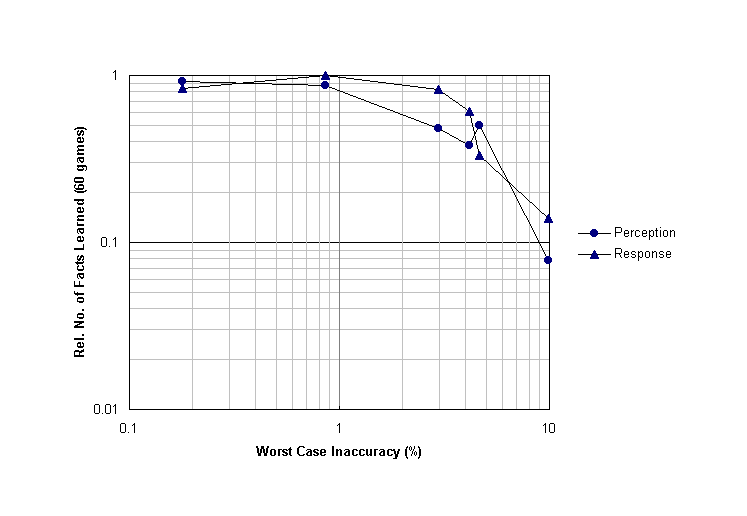
The plot shows the relative number of facts learned by the simulated
student over 60 games.
This set of simulations is a little harder to interpret, because
the ideal expectation is not so simple as in the previous example.
A plausibility argument can be given to explain the results
semiquantitatively. One expects the effect of inaccurate perception
to be negligible if the worst-case error rate is less than 1%.
Further, at a worst-case error rate of 10%, one would expect
substantially slower learning. The simulations are consistent
with these general expectations.
This result is very likely to be sensitive to the lack of
metacognition in the student model. STU is currently unable
to learn about its own learning characteristics, and cannot
make the simple (?) adjustment of reading each problem twice
or typing a little more slowly to increase accuracy.
Back to Previous Example
Return to Phase I Results Page or ANSR / DOEd SBIR Project Page
Return to ANSR Home Page or Site Contents -- or -- Contact ANSR.