 The "Super Student" simulation was performed to test everything under
near-optimum learning conditions.
The "Super Student" simulation was performed to test everything under
near-optimum learning conditions.
The "Super Student" simulation was performed to test everything under
near-optimum learning conditions.
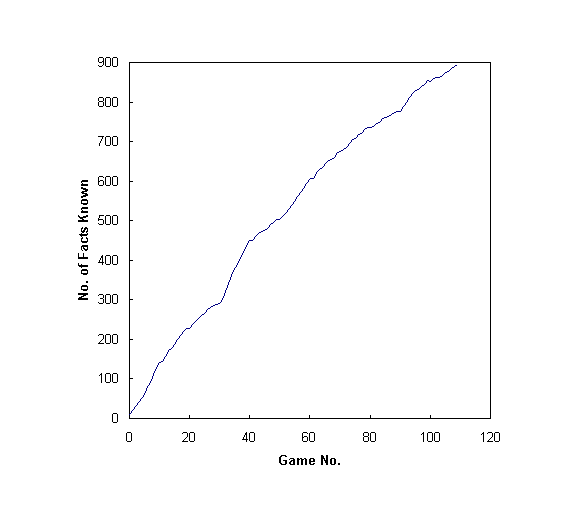
In this case, the simulation is run for several (11) 10-game
sessions. TUT progresses through the entire set of five
FactBases: Typing (Number Recognition), Addition, Subtraction,
Multiplication, and Division. The student learns the
entire dataset at an average of 2.8 presentations per new fact.
Philosophical aside: Aren't computers wonderful? Few of us humans could match that learning performance, even on a good day! On the other hand, if I hadn't held my computer back using a NN to simulate human behavior, the computer could have "memorized" the entire dataset in much less time, with much less programming! Or, even worse, I could have used the knowledge (programming) a $5 calculator was "born" with to calculate all the results with no memorization at all. Does this mean humans should give up trying to do arithmetic? I don't think so, for several reasons. (1) There are still too many times and places where your head is more accessible than a calculator. (2) Also, human understanding of arithmetic is important as a tool for understanding some aspects of the real world. (3) There's intrinsic beauty and value in a mathematical system that works so well and so predictably. (4) I think it's good for people to have some contact with "absolutes"! (5) Finally, it's going to be necessary for many years to come to have people who can design and understand the machines that can (mis)calculate so rapidly! [End of lecture!]
Small variations in learning rate occur due to the "Phasing" structure
and the requirement that a student complete a given logical set of
facts (FactGroup) before proceeding to the next set.
Continue to Next Example
Return to Phase I Results Page or ANSR / DOEd SBIR Project Page
Return to ANSR Home Page or Site Contents -- or -- Contact ANSR.