As a background for understanding Learning Disabilities, it is important to understand the learning process itself in human beings. Cognitive models of the learning process are rudimentary, though progressing towards greater detail and with stronger research foundations. It is interesting to note a large and on-going mutual interaction between the fields of neuropsychology/learning, and artificial neural networks (NN) [AN92, BE91, SW94, CH95]. The functional blocks defined within cognitive models of the human mind are both influencing and influenced by NN research.
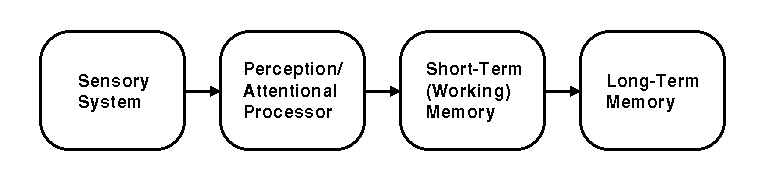
Here is a schematic model of some of the processes involved in learning that is either implicit or explicit (e.g., SW94, CH95) in much of the current educational and psychological literature:
The sensory organs and their associated networks of neurons perform the first
steps in the learning process: acquiring information from the world. Perception
begins with the raw signals of the sensory organs, e.g., the outputs of the
optic or auditory nerves. The process of perception includes attentional mechanisms
that isolate "important effects" from the large body of sensory data. The output
of the perceptual preprocessing is an edited, condensed, and manipulable form
of the sensory experience. Short-term or working memory (I’ll use STM or WM
interchangeably, but there is actually a complex and operational distinction
used by some authors) is analogous to the CPU of a computer, with biological
variations. The key functions of STM are not understood in much detail, but
they include the functions that are normally defined as "cognition" and "meta-cognition":
comparison of current perceptions with various kinds of previously acquired
knowledge, interpretation in terms of language concepts, induction, deduction,
and low- and high-level decision making. A key biological feature of STM in
humans is its short term (of order seconds) and its limited capacity (perhaps
3-9 "facts" or "objects"). The main learning function of STM is to encode the
perceptual knowledge in a form that can be retained in Long Term Memory (LTM).
Two key features of human LTM are retention of knowledge in organized or associated-access
patterns and relatively long term storage (of order years). Another significant
feature of LTM is that the storage process itself is relatively effort- intensive:
establishing long-term memories requires multiple passes and considerable effort
for most people.
This schematized model of learning is enormously simplified compared to the full functionality of the human nervous system: even at this level of detail, there exist parallel sensory and preprocessing paths associated with the different senses. The model presented does not explicitly deal with motor functions and the role of interaction in learning. A crucial unresolved conceptual issue is this: "What range of internal conceptual representations can be useful for human cognition?" It is fairly clear that many people rely most heavily on language-based representations for much of their thinking. But if some aspect of language processing is poor in a given individual, do alternatives exist? If so, what? How would one tap the resources? What are the costs and benefits? Furthermore, this schematic model does not begin to provide details or any quantitative predictions.
Continue viewing the ANSR DOEd SBIR Project by using your browser's "Back" button.
Return to ANSR Home Page or Site Contents -- or -- Contact ANSR.